I visited it 47 years later by chance
Although I don’t remember exactly when, it must be on a spring or early summer night in 1979. I was a junior in high school, got accepted to spend a whole year in the US as an exchange student through an organization called AFS, then called American Field Service. Before I left for the US in July, my father took us to a fugu (blowfish) restaurant for a family dinner.
My father, being the owner of a small electricity-construction company, was working hard and seldom at home for dinner time. Even on the weekend, he would usually be gone visiting worksites. So, going out for dinner with the family itself was a special event for me. My father must have realized that not seeing his only daughter for the whole year was not a trivial matter.
And considering that his daughter would be away from Japan for a whole year, my father must have thought it through to decide which restaurant to take us.
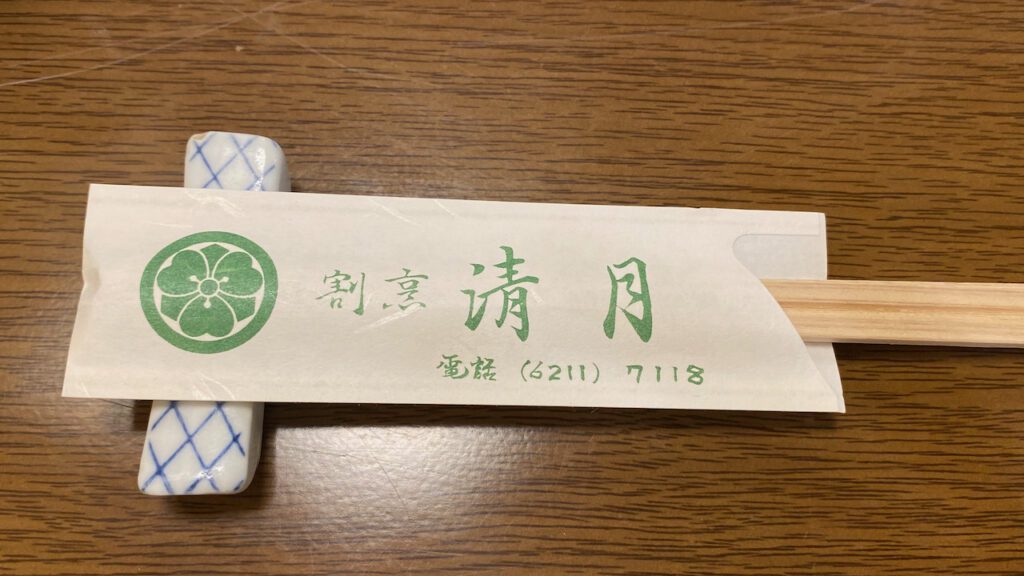
The restaurant was called Seigetsu 清月. Our family was taken to a tatami-mat room upstairs. We were the only customers in a rather large room.
From the way my father and the okami, or proprietress of the restaurant, were talking to each other, I sensed that they had known each other for a long time. I assumed my father must have often used this place to entertain his clients.
As the first dish, Tessa, or fugu (blowfish) sashimi, was served. Very thin slices of fugu meat were spread neatly like flower petals on a large, flat, round porcelain plate. The firm texture of the thin slice was a surprise for me. It must have been my first time to eat fugu, and I loved it!
The main dish was “Tetchiri” or fugu hot pot. The fugu meat was cooked with various kinds of vegetables and tofu. The broth was brilliantly light both in color and the taste. The delicate fugu meat was delicious with the ponzu, the mixture of soy sauce and citrus juice.
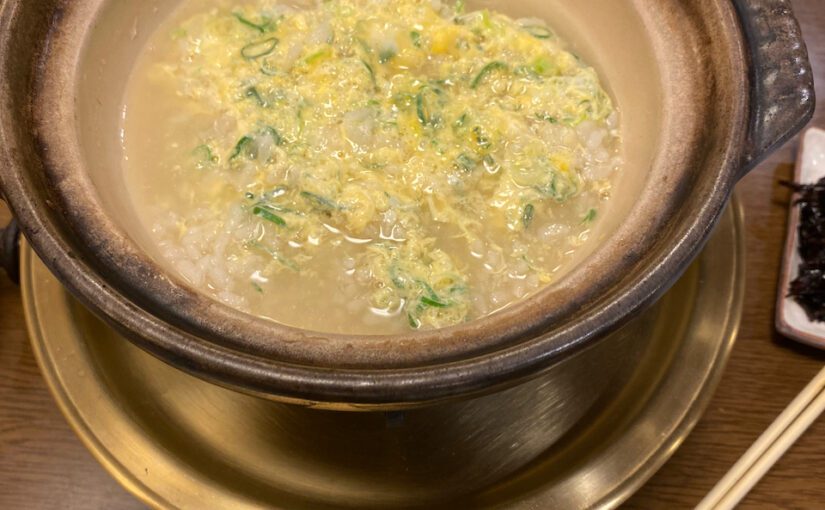
After we ate Tetchiri, the okami brought white rice. She cleared away most of the leftover vegetables and flakes of fugu meat carefully with a mesh ladle. Into the transparent broth left in the pot, she put rice and kept on cooking for a while. Then she poured beaten eggs on the rice. “Once you pour eggs, you turn off the heat and close the lid. You cook the eggs with the residual heat of the rice and the broth. That’s the secret of making the most delicious Ojiya,” said the okami.
It didn’t take long. Maybe only three or four minutes. The thick pot made of clay kept the rice and broth warm. When the okami opened the lid, the rice, broth, and the eggs were harmonized to make the perfect Ojiya. After she served the Ojiya to four individual bowls, she instructed us to pour a little bit of ponzu and sprinkle crushed nori (dried seaweed) on top of it. The Ojiya was heavenly.
Time has passed. After I returned from the US, our family did go out for dinner, maybe several more times, but never back to Seigetsu.
I moved to the US to live. My father passed away in 2004.
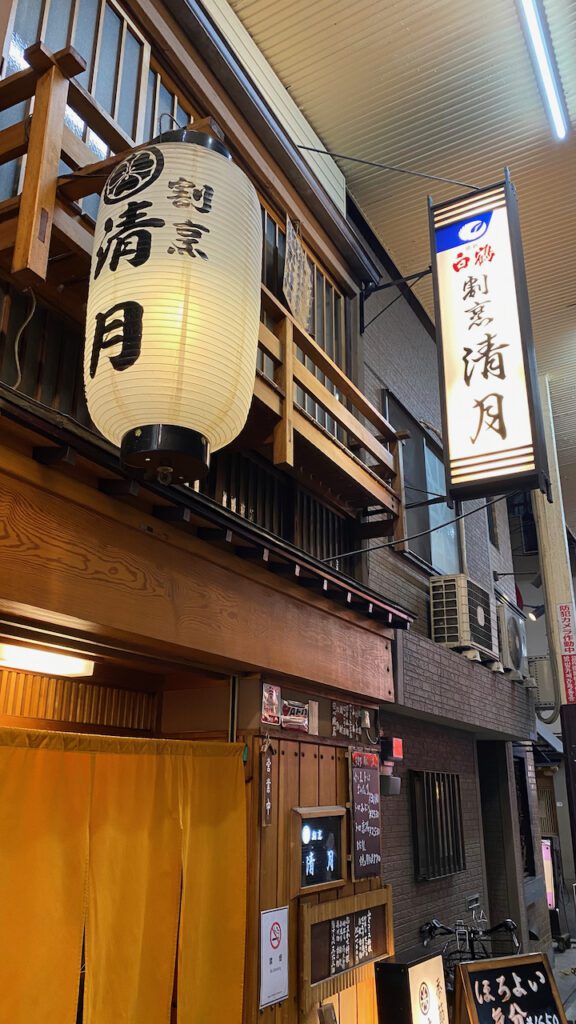
On a sunny day in April, 2025. After we went to see Yoshitsune Senbonzakura at the National Bunraku Theatre, my mother and I were hungry. Along the way, walking back to the subway station from the theatre, I happened to turn my head on the right, and noticed the character on the sign of an old Japanese-style restaurant. I could only see the second character and it was “月.”
I couldn’t help but approach toward the sign to see what the first character. It was “清.”
Does the restaurant serve fugu? The tagline of the restaurant said only ‘Kappo,” a more generic term of a type of Japanese cuisine. Closely looking at the list of items shown on the menu by the door, I found the word “fugu.”
This must be the one. After 47 years, I finally found the restaurant that I hadn’t even been particularly looking for or seriously thought of.
My mother and I went inside. The woman in an apron welcomed us. She looked not much older than me. We were seated on a small tatami section on the opposite side of the counter. Beyond the counter was a chef working alone. He looked around in his seventies.
“How long has this restaurant been here?” I asked. The chef responded, “My parents started this restaurant shortly after the war was over. My mother, in her late 90’s, still comes here to work once or twice a week. I want to retire someday, but not as long as my mother is still alive.”
My mother and I ordered a hot pot. When it came to adding rice to the broth to make Ojiya, I asked the woman in an apron. “As soon as you pour eggs, you close the lid, and turn off the heat, right?” The woman said, “I don’t know about any other restaurants, but that’s the way our restaurant has always been doing.”
The meal was more than delicious. My mother and I would definitely come back here again, hopefully soon. Hopefully when the okami is working here. To ask her if she by any chance remembers my father…